Description
Acacia disparrima – Southern Salwood
Family: Fabaceae
Packet Size: 40 seeds
Description
Acacia disparrima, commonly known as Southern Salwood or Brush Ironbark Wattle, is a northern New South Wales and Queensland native shrub or tree found around open forest, woodland and rainforest margins.
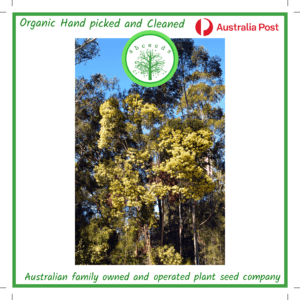
Its curved grey-green leaves show several prominent lengthwise veins. Slender, pale-yellow to lemon-yellow flower spikes appear along the branches, often in summer and autumn, providing a different seasonal display from winter-flowering wattles.
Key Features
- Flowers: Pale to lemon-yellow cylindrical flower spikes, commonly between January and May.
- Foliage: Grey-green, gently curved leaves with prominent parallel veins.
- Habit: Shrub or small to medium tree, often approximately 3–12 m tall.
- Garden uses: Naturalistic native planting, suitable revegetation sites and larger gardens.
Growing Conditions
- Position: Full sun to lightly sheltered sites.
- Soil: Provide well-drained soil; the species occurs in a range of woodland and forest-edge habitats.
- Watering: Water during establishment and adjust irrigation to local conditions.
- Climate: Well adapted to suitable coastal and near-coastal regions of eastern Australia.
- Pruning: Prune lightly when young only if a more compact or balanced habit is needed.
Seed Propagation
- Prepare: Wattle seeds usually have a hard, water-resistant coat. Lightly rub one side with fine sandpaper or carefully nick the seed coat without harming the embryo. Soak in room-temperature water for around 12–24 hours before sowing.
- Sow: Sow seeds about 5 mm deep in a clean, freely draining seed-raising mix.
- Position: Keep in a warm, bright, sheltered place; protect young seedlings from harsh direct midday sun.
- Moisture: Keep the mix consistently moist but not waterlogged.
- Germination: Timing varies with temperature, seed age and nicking or scratching the seed coat. Allow additional time for any seeds whose coats have not softened.
- Transplant: Move seedlings into individual pots once they have true leaves and can be handled without damage.
Growing Note: For ecological plantings, check that Southern Salwood is indigenous to the planting area and use appropriate local provenance.

Reviews
There are no reviews yet.